Blog

Social Isolation’s Impact on Health Outcomes and Health Spending

Taken from bipartisanpolicy.org

Research has that found that both social isolation and loneliness increase mortality across age, gender, and country of origin. Specifically, one roundtable participant noted a recent meta-analysis based on a comprehensive literature search (a review of publications from 1980 to 2014 on 3.4 million subjects) that found a 29 percent increased risk of mortality associated with social isolation and a 26 percent increased risk of loneliness, which were both consistent worldwide. Roundtable participants also explored other recent research that compared social isolation with well-established risk factors and that recognized that isolation could be an even bigger public health threat than smoking or obesity and that it could raise the risk of premature death by up to 50 percent.

With these statistics in mind, roundtable participants also discussed the significant impact of social isolation on health care spending. They noted a recent collaborative study by the AARP, Stanford University, and Harvard University that found the Medicare program spends an estimated $134 more per person monthly ($1,608 annually) for every socially isolated older adult, compared with those who were not socially isolated—a level of spending comparable to what Medicare pays for certain chronic conditions, such as high blood pressure or arthritis. In total, the study estimated that a lack of social contact among older adults is associated with an estimated $6.7 billion in additional Medicare spending annually.

Given the significant health and economic impacts of social isolation and loneliness, roundtable participants agreed the time is now to develop collaborative solutions to improve social connectedness, particularly among the nation’s rural and aging seniors.
An Evaluation of the Effectiveness of the Alabama Board of Medical Scholarship Awards

The Alabama Board of Medical Scholarship Awards (BMSA) is an Alabama legislature program that was created as an incentive to increase the supply of primary care physicians (family practice, internal medicine, and pediatrics) and encourage their practice in the state’s rural medically underserved communities. Application for educational loans are available to all students enrolled in medical schools in the State of Alabama. Each loan recipient enters into a contractual agreement with the Board of Medical Scholarship Awards whereby the recipient agrees to practice primary care in a medically underserved community. For default or termination of a loan the recipient is required to repay the principle of the loan plus a penalty of up to 200% of the total principle amount of the loan.

The failure of a loan recipient to perform his or her contractual agreement with the Board of Medical Scholarship Awards or to pay the amount he or she is liable for under this program shall constitute a ground for the revocation of his or her license to practice medicine.

143 primary care residency graduates have completed or are currently fulfilling their service obligations.

The effectiveness of the BMSA educational loan program was evaluated using criteria based on stated intent as expressed in the Alabama legislature and standard metrics for measuring outcomes of educational loans, scholarships and incentives. The criteria used to evaluate the effectiveness this program were:

  • Increase the supply of primary care physicians in the state of Alabama
  • Encourage practice in the state’s rural medically underserved communities
  • Attract young primary care physicians to rural Alabama (replace Alabama’s aging rural primary care physician workforce)
  • Prudent use of state dollars

New ARHA Church Directory for Healthy Living

Churches throughout rural Alabama have the desire for professionals to come in and provide health fairs, screens, or classes to assist their congregates with physical health.  This directory is designed to allow churches to sign-up to receive such assistance as available, and also to connect those wishing to provide assistance with churches willing to accept it.  There is no cost to participate, and the sign-up form takes less than 2 minutes to complete.

Click here to access the sign-up form and begin the journey of healthy living with us!

Tell Us Your Story

One priority of the Alabama Rural Health Association is to magnify your voice to legislators, policy advisors, and officials.  But to do this, we need to hear your story so that we can tell it for you.

Have you had issues with one of the following?

  • Delayed or incorrect insurance payments?
  • Increased cost due to specific regulatory burdens?
  • Decreased revenue due to funding or reimbursement cuts?
  • Significant delays with enrolling with public or private insurance?
  • Issues with obtaining an NPI number in a timely fashion?

Contact us at arha@arhaonline.org to inform us of any issues that you have experienced so that we can assist you and tell your story.  When you reach us, please provide as much detail as possible.

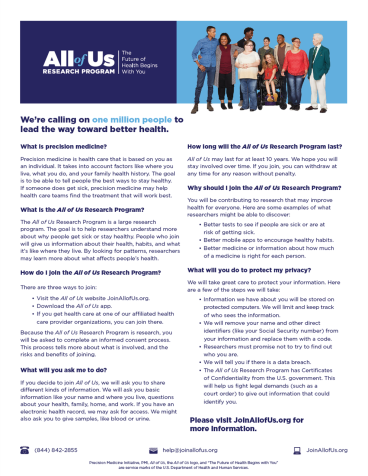
ARHA Supports the All of Us Research Program

Screen Shot 2019-08-29 at 9.54.02 AM

The All of Us Research Program began national enrollment, inviting people ages 18 and older, regardless of health status, to join this momentous effort to advance individualized prevention, treatment and care for people of all backgrounds. Part of the National Institutes of Health, All of Us is expected to be the largest and most diverse longitudinal health research program ever developed.

Participants are asked to share different types of health and lifestyle information, including through online surveys and electronic health records, which will continue to be collected over the course of the program. Those who join will have access to study information and data about themselves, with choices about how much or little they want to receive.

Data that are collected will be broadly accessible to researchers of all kinds, including citizen scientists, to support thousands of studies across a wide range of different health topics. By doing so, they are hoping to discover how to more precisely prevent and treat other health conditions. Knowledge gained from this research could help researchers improve health for generations to come.

Why All of Us is Important for Patients

Health care is often “one size fits all” and is not able to fully consider differences in individuals’ lifestyles, environments, or biological makeup. This is because we have limited data from past research studies about how those elements interact. The average patient is often prescribed drugs and treatments as if they are all the same. Learning more about the differences between individuals can help researchers develop tailored treatments and care for all people.

How All of Us Benefits Health Care Providers

Today there are too few conditions with evidence and options for individualized care. Too often, patients from underserved communities have not been included in clinical research, and our ability to care for diverse populations is diminished as a result. More data, discoveries, and tools can help providers to give their patients customized care more easily, especially for those communities that are disproportionately impacted by health issues.

Why Diversity Matters

Historically, many segments of the U.S. population have been left behind in medical research, including people of color, sexual/gender minorities, those with lower socioeconomic and educational status, rural communities, and other groups. The result is significant health disparities. The All of Us Research Program seeks to help fill in the gaps of information about those communities that previously have not been well represented.

How to Join the All of Us Research Program

The program is seeking one million or more people from all walks of life to participate in this historic endeavor. Those interested in joining the program can do so by visiting, www.JoinAllofUs.org. Enrollment is open to all eligible adults who live in the United States.